Gooseneck Versus Bumper Pull Trailers Compared
Published October 18, 2026
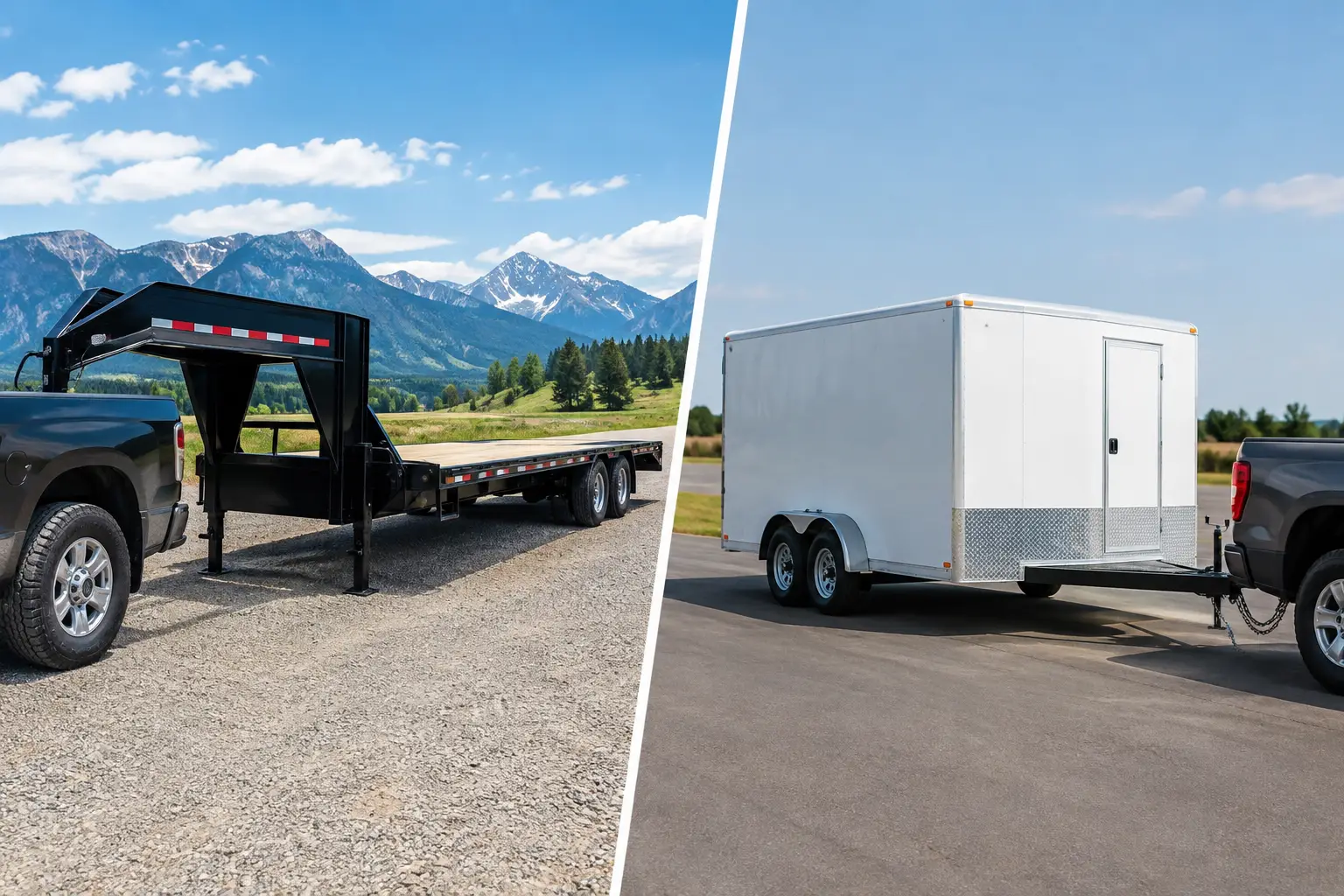
A trailer can look right in the photos and still be the wrong fit when it is loaded at daylight. The real question in gooseneck versus bumper pull trailers is not which one is “best.” It is which one matches your truck, your typical load, the roads you run, and the kind of work you expect it to do.
A bumper pull may be the sensible choice for hauling a compact tractor, a few round bales, or a side-by-side behind a daily-driver pickup. A gooseneck earns its keep when the loads get heavier, longer, or more frequent. Both designs have a place on a working farm. The trouble starts when a buyer focuses on deck length, paint, or asking price and skips the weight ratings and hitch setup.
Gooseneck Versus Bumper Pull Trailers: The Main Difference
The hitch location changes nearly everything. A bumper pull connects at a receiver hitch behind the truck's rear bumper. Its tongue weight sits behind the rear axle. A gooseneck couples to a ball in the pickup bed, generally over or just ahead of the rear axle. That position puts more of the trailer's downward force where the truck can handle it better.
This is why a properly loaded gooseneck is usually more stable with heavy loads. It has less leverage working against the truck, tracks better at highway speed, and is generally less prone to sway. That matters when hauling a loaded stock trailer, skid steer, hay equipment, or a long flatbed through wind, traffic, and uneven county roads.
A bumper pull is not automatically unsafe or light-duty. A well-matched bumper pull with sound brakes, properly inflated tires, correct tongue weight, and a capable tow vehicle can do a lot of work. But as trailer size and gross weight climb, the margin for error gets smaller.
Truck Fit Comes Before Trailer Shopping
Start with the door sticker and owner's manual on the actual truck, not what a similar model is rumored to pull. You need to know the truck's payload rating, tow rating, rear axle rating, gross combined weight rating, and hitch ratings. Those numbers must work together.
With a bumper pull, the tongue weight commonly falls around 10% to 15% of loaded trailer weight. A 10,000-pound loaded trailer can put 1,000 to 1,500 pounds on the hitch. That weight counts against truck payload along with passengers, tools, dogs, fuel tanks, and anything else in the cab or bed.
Goosenecks commonly place roughly 15% to 25% of loaded trailer weight in the bed. The truck may tow the trailer more confidently, but the hitch weight can be substantial. A 14,000-pound loaded gooseneck could put more than 2,000 pounds on the truck. A half-ton pickup is often out of the conversation before you ever discuss trailer brakes or deck length.
Do not assume a diesel badge makes the truck ready. A truck can have plenty of engine and still run short on payload or rear axle capacity. Likewise, a used trailer's advertised 14,000-pound GVWR does not mean your pickup can legally or safely handle it at that weight.
Where a Gooseneck Makes Sense
A gooseneck is usually the better tool for regular heavy hauling. Livestock producers moving larger groups, hay operators pulling loaded flatbeds, and equipment owners hauling tractors or skid steers will notice the difference in stability and control. The longer deck options also make room for equipment, attachments, pallets, or a mix of supplies that would crowd a short bumper pull.
A gooseneck can also turn tighter than many bumper pulls. Once you are used to it, backing can feel more predictable because the hitch point is closer to the truck's rear axle. That is helpful at a crowded farm shop, sale barn, or narrow loading area.
The trade-off is the pickup bed. The gooseneck hitch takes up useful bed space, and the trailer's neck limits how sharply you can turn before the trailer contacts the cab. Short-bed trucks especially need proper clearance. A sharp turn with inadequate clearance can make an expensive mess of the truck cab, trailer nose, or both.
Goosenecks also cost more to buy in many comparable sizes, and a buyer needs a bed-mounted hitch installed correctly. If you only haul occasionally, that extra expense and lost bed space may not pay back.
When a Bumper Pull Is the Better Buy
A bumper pull is often the practical answer for lighter, occasional work. It is simpler to hook up, leaves the pickup bed open for feed, fencing tools, saddles, or a fuel tank, and can be moved between compatible vehicles more easily. For a homesteader or small operation, those advantages are real.
They also make sense where access is tight. A shorter bumper pull can be easier to park beside a barn, tuck into a shed, or maneuver through a small property. If the trailer spends most of its life hauling a UTV, mower, small tractor, or a few animals on local runs, paying for a large gooseneck may not be money well spent.
That said, do not buy a bumper pull simply because the truck already has a receiver. Match the receiver class, ball mount, ball rating, safety chains, brake controller, wiring, and trailer brakes to the job. A weight-distribution hitch may improve handling for certain bumper-pull loads, but it does not change the truck's factory weight limits.
Look Past the Trailer's Empty Weight
When comparing used trailers, sellers and buyers should talk in real numbers. Ask for the trailer's GVWR, empty weight, axle ratings, tire load range, brake condition, coupler size, and deck length. Then consider the load you actually plan to carry.
A 20-foot equipment trailer may seem like plenty of trailer until a tractor, loader, implement, chains, fuel, and toolbox are on it. A stock trailer has its own moving-load concerns. Cattle do not stay perfectly centered, and livestock weight can shift during braking and corners. A trailer that feels adequate empty may tell a different story with a full load.
Check the trailer's data plate, but inspect the hardware too. Look for uneven tire wear, bent hangers, cracked welds, brake wiring patched with household connectors, weak breakaway batteries, loose deck boards, and rust around the coupler or frame. Honest hour meters matter on equipment; honest brake and tire condition matter on trailers.
Loading and Driving Matter More Than the Hitch Style
No trailer design makes up for poor loading. Place weight so the truck has adequate hitch weight without overloading the rear axle. Secure equipment at proper tie-down points. Use rated chains or straps, cross chains where appropriate, and binders that are in good shape. For livestock, check gates, latches, flooring, dividers, ventilation, and escape-door function before leaving the yard.
Take the first few miles seriously. Feel the brakes, watch for sway, and stop to recheck straps, chains, couplers, and tire heat. A tire that looks fine at the farm can show its problem after ten miles at road speed. When buying used, it is reasonable to ask the owner whether the trailer can be inspected cold, connected to a truck, and checked with the brakes and lights working.
The Straight Answer for Buyers
Choose a gooseneck if you routinely pull heavier loads, need a longer deck, and already have a truck with the payload and hitch setup to carry the pin weight. Choose a bumper pull if your loads are moderate, your truck doubles as a daily driver, and keeping the bed available matters more than maximum towing stability.
For either type, buy the trailer you can safely load today, not the one you hope your truck can handle someday. Ask direct questions, inspect it in person, and treat every used trailer as sold as-is, where-is until you have checked the numbers and the condition yourself. The right trailer is the one that gets the load there without asking your truck, brakes, tires, or judgment to do more than they were built to do.
See what your machine is worth
Listings are free and livestock sells at 0% commission. Buyers contact you directly.