Private Sale Versus Livestock Auction: Which Wins?
Published October 22, 2026
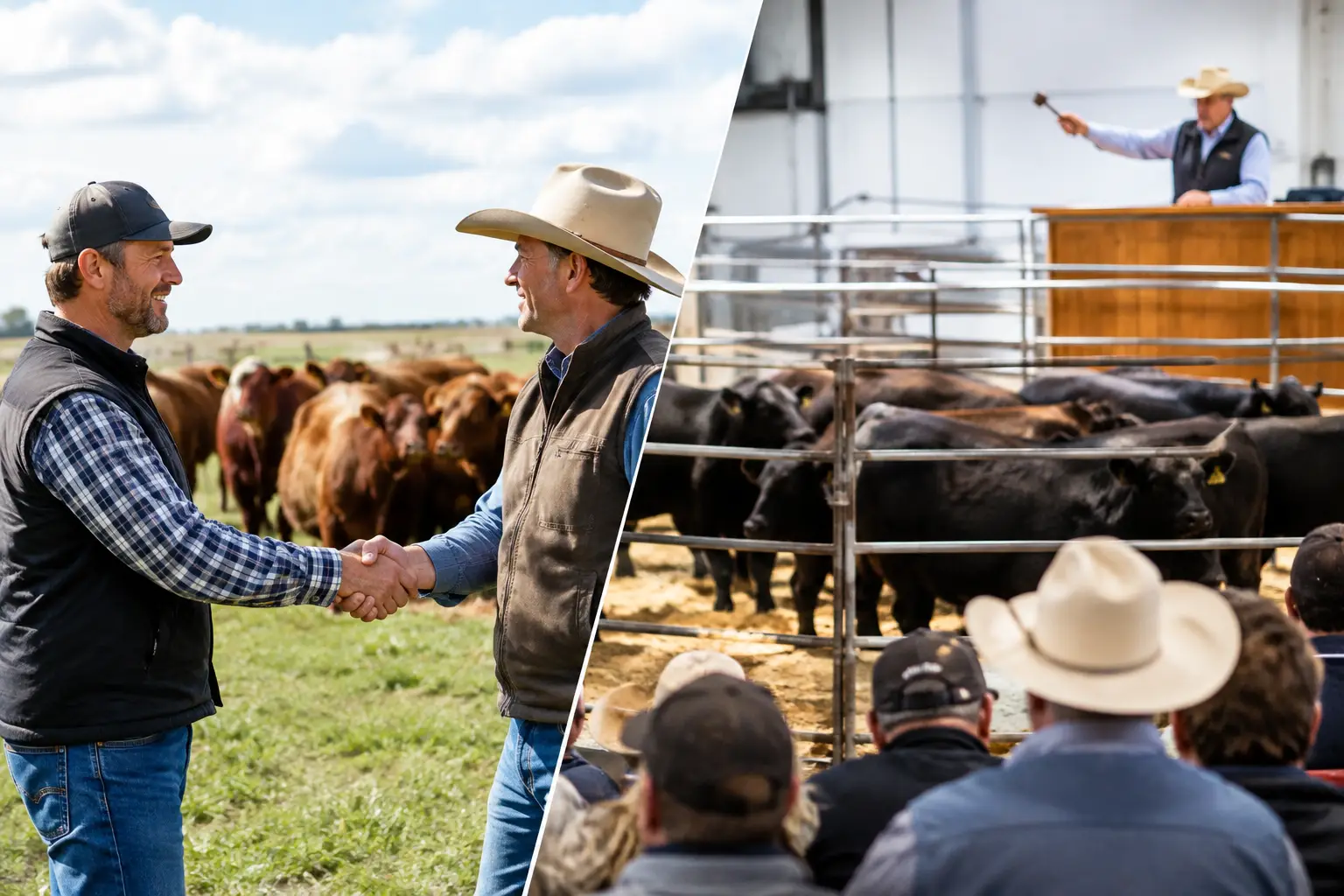
A set of bred heifers ready to move, a pen of weaned calves coming off grass, or a herd dispersal can put a seller in the same spot: private sale versus livestock auction. Both can work. The better route depends on what you are selling, how soon it needs to be gone, whether the cattle are differentiated enough to earn a premium, and how much control you want over the deal.
A county sale barn remains a reliable place to turn livestock into cash on a set day. A direct owner-to-owner sale gives you time to show buyers what they are buying and negotiate a price that reflects the cattle. Neither route guarantees top dollar. Good cattle, honest representation, sound paperwork, and practical hauling arrangements matter either way.
Private Sale Versus Livestock Auction: The Real Difference
The main difference is not simply where the cattle change hands. It is who controls the price and the process.
In a livestock auction, competing buyers establish the price in real time. That is useful when demand is strong, the cattle fit a familiar market class, and you need a definite sale date. Once the animals cross the scale and the bidding is done, the sale is generally finished. The market may also handle much of the yarding, weighing, and buyer traffic that would otherwise fall on the seller.
In a private sale, the owner sets an asking price or negotiates directly. You can sell by the head, by the pound, on a delivered basis, or with terms clearly agreed upon before loading. You decide who gets to inspect the cattle, whether to sort lots, and when the buyer picks up. That control can protect value, but it also requires the seller to market the livestock, answer questions, and wait for the right buyer.
The trade-off is plain: auctions deliver speed and price discovery; private sales deliver flexibility and price control.
When an Auction Makes Good Sense
An auction is often the practical choice when time matters more than holding out for a particular number. If feed is short, a lease is ending, weather is closing in, or cattle need to move before a health or management deadline, a sale barn provides a known outlet. You do not have to build a buyer list from scratch or schedule several farm visits.
Auction markets can also work well for cattle that are straightforward to evaluate in a sale-ring setting. A uniform load of healthy, properly weaned calves with a known vaccination program may draw strong interest when buyers are actively filling orders. The same can be true for cull cows, slaughter bulls, market goats, feeder lambs, and other classes where current market conditions drive most of the value.
Competition is the upside. If multiple buyers want that kind, weight, and quality of livestock on that day, bidding can exceed what one private buyer offered last week. The seller does not need to guess whether the first reasonable offer is the best offer.
But auctions have limits. You are exposed to that day’s market, that day’s buyer turnout, and the way your livestock present after hauling and standing in a strange environment. A cold rain, a crowded run, a market dip, or an off-weight group can change the result. The cattle may be worth more to a buyer who understands their genetics, disposition, health history, or production record than they are to a buyer making a quick decision from the stands.
Auction costs should be understood before the truck leaves the farm. Ask about commission, yardage, insurance, shrink, check-off deductions, hauling, and any special sale charges. A strong gross price is not always the strongest net price.
When a Private Sale Can Pay Better
Private sales tend to shine when the livestock have a story that deserves more than a few seconds in the ring. Registered breeding stock, bred cows with complete records, gentle family horses, show prospects, dairy replacements, hair sheep, pasture-raised feeder pigs, and well-developed replacement heifers often fit this category.
A serious buyer may pay more when they can see real photos, study records, inspect feet and udders, ask about disposition, and look at the animal in the environment where it has been managed. For a cow-calf producer, a buyer may care about calving interval, sire group, vaccination protocol, frame, and the kind of country the cattle have been running. Those details are hard to communicate in a fast auction sequence.
Private selling also lets you market the right lot size. Instead of sending 18 bred cows through one at a time or in small groups, you may offer the full package to a buyer looking to build a herd. Or you can separate a few top-end females from the commercial group rather than letting the whole set average together.
The seller has more room to set terms, too. You can require a deposit, establish a pickup deadline, specify that the cattle are sold as-is from the farm, and decide whether the buyer or seller handles health papers, brand inspection, testing, and hauling. Put those terms in writing. A handshake still matters in rural trade, but clear written details prevent honest misunderstandings about price, possession, risk, and delivery.
The downside is time. Private buyers can ask plenty of questions, visit twice, say they need to talk to a partner, and disappear. Some will want a lower price because they know you are trying to avoid the auction. Good screening helps, but the seller carries more of the work.
Price Control Is Not the Same as Price Certainty
Setting an asking price can feel safer than taking auction risk. It is not a guarantee that the cattle will sell for that number. An unrealistic private-sale price can leave livestock sitting longer than planned, eating feed and tying up pasture.
Before posting a price, look at current market reports for comparable weight, class, and quality. Then account for what makes your livestock different. Are they vaccinated and bunk broke? Are they exposed or confirmed bred? Are the papers current? Do they have a documented health history? Are they quiet enough that a buyer can handle them safely? Those factors may justify a premium, but only if buyers can verify them.
It also helps to know your walk-away point. If a buyer makes an offer, decide whether the net amount is better than what you reasonably expect after auction commission, hauling, shrink, and the risk of a weaker sale day. That comparison keeps negotiations grounded.
Buyer Reach Changes the Equation
A local sale barn brings local and regional buyers together on sale day. That is hard to beat for immediate traffic. Yet the buyer best suited to your livestock may be two counties away or several states over, especially for specialty breeds, breeding stock, or equipment that is hard to find.
A direct marketplace can broaden that reach without putting a dealer or broker between owner and buyer. BarnBridge, for example, allows livestock sellers to create fixed-price listings with direct communication and 0% livestock commission. That does not eliminate the need for a careful transaction. It gives a seller another way to put the cattle in front of people who are actively looking.
Good listings do the work before the first phone call. Use current photos and video, state the location, list head count and approximate weights, explain vaccination and breeding status accurately, and disclose anything a buyer will see on inspection. If a cow is open, say she is open. If a horse has a scar, show it. Honest details attract better buyers and waste less time.
Protect Both Sides of a Private Deal
Private transactions are direct, not casual. Confirm the buyer’s name and phone number, agree on price and payment method before loading, and do not release livestock based on a screenshot of a payment. Verify funds according to your bank’s process. For a larger transaction, a wire transfer completed before pickup or another verified method may be appropriate.
Use a bill of sale that identifies the parties, date, livestock description, number of head, price, and any representations made. Include health documents, registration transfers, brand paperwork, and state-specific movement requirements when they apply. Interstate movement rules, brands, testing, and certificates of veterinary inspection can vary, so check the requirements for the origin and destination before the truck arrives.
Buyers have responsibilities as well. Inspect before purchase when possible, ask direct questions, arrange capable hauling, and be ready to load on the agreed date. Sold as-is, where-is should not excuse dishonesty from a seller, but it does mean a buyer should not assume facts that were never promised.
Pick the Method That Fits This Set of Livestock
There is no rule saying every animal must go through the same channel. A producer might consign commodity calves to the weekly market while privately offering the best replacement heifers as a uniform group. A herd dispersal may use an auction for speed, while a few registered cows are marketed directly to buyers who value their records.
Use the auction when you need a firm sale date, broad immediate competition, and a simple way to move livestock that fit a well-known market class. Use a private sale when the animals have verifiable value beyond weight and grade, when you can market them well, and when you have time to wait for the right buyer.
The best deal is not always the highest number somebody says over the phone or the loudest bid in the ring. It is the sale that leaves both sides clear on the cattle, the money, the paperwork, and the pickup plan.
See what your machine is worth
Listings are free and livestock sells at 0% commission. Buyers contact you directly.